A white paper exploring why technology investments so often fall short of expectation, and how leaders can build the system readiness needed to turn implementation into transformation.
Executive Summary
Technology alone doesn’t transform organisations, people do. Yet many technology initiatives focus on systems and tools while overlooking the system that enables them to succeed: the people, structures, culture, and leadership practices that shape how work actually gets done.
At Business Vitality, we call this ‘system readiness’ - the alignment of people, purpose, and process that ensures new technology can be adopted, embedded, and sustained. Without it, even the best investments risk underperforming or amplifying existing organisational challenges.
This white paper explores how leaders can prepare their organisations for technology change by thinking in systems, not silos. It outlines the patterns we see across industries, the cultural and structural shifts required for true transformation, and the practical frameworks that enable lasting success.
The Transformation Paradox
Technology promises progress - greater productivity, improved customer experience, smarter decisions. Yet across industries, transformation efforts continue to underdeliver.
Recent industry research suggests that fewer than 50% of digital initiatives achieve their intended business outcomes, and in the broader transformation context, as many as 88% of programmes fail to deliver against their original ambition (Bain & Company, 2024; Gartner, 2024).
The paradox lies in where attention is placed. Projects often focus on features and functionality rather than the organisational and cultural systems that determine whether the technology will thrive. When structures, roles, work rhythms and leadership behaviours stay the same, new technology inevitably defaults to old ways of working.
The Real Nature of Technology Change
Technology change is, at its heart, culture change - it alters how people collaborate, make decisions, and experience their work, often disrupting routines, exposing inefficiencies, and challenging unspoken norms. And there’s an emotional cost too: when the familiar becomes unfamiliar, people often feel a loss of competence, certainty, and psychological safety - all of which directly shape adoption. When these cultural realities aren’t addressed, the result is tension rather than transformation.
Many organisations discover too late that technology adoption amplifies existing challenges, instead of resolving them. Silos become more visible, accountability gaps widen, and disengagement grows. Instead of uniting teams, the new capability reinforces fragmentation.
True transformation requires a deliberate approach to how the organisation thinks, learns, and adapts, not just what tools it uses. This means designing the work environment and enabling conditions, such as leadership practices, work rhythms, and governance structures, around the behaviours and outcomes the technology enables.
What ‘System Readiness’ Really Means
System readiness is the organisational equivalent of preparing the soil before planting. It ensures that when new technology arrives, the environment is ready to support its growth. It means that:
- People understand why change is happening and how it connects to purpose.
- Leadership is aligned on priorities, behaviours, and accountabilities.
- Processes and workflows are coherent and adaptable.
- Governance, data, and decision-making support continuous learning.
- Culture fosters trust, curiosity, and collaboration.
At Business Vitality, our Organisational Capability Model describes the six attributes found in every high-performing organization: Focus, Accountability, Flexibility & Agility, Trust & Safety, Thriving People & Culture, and Committed Stakeholders. These attributes form the foundation of system readiness, ensuring the conditions are right for technology to deliver its intended value.
Common Patterns of Failure
Across industries, we continue to see recurring patterns, not of technical failure, but of systemic failure.
Technology does what it’s designed to do; the surrounding organisation often doesn’t.
- The CRM that never landed: because sales structures, rhythms and incentives didn’t change, and leaders still rewarded short-term transactions over long-term relationships. The system asked for collaboration, but culture rewarded competition.
- The ERP that revealed more than it resolved: transparency without governance exposed deeper performance issues. Without clear decision rights or agreed accountabilities, the data only amplified existing tensions.
- The agile toolset without agility: teams adopted rituals and sprints, but decision-making remained centralised and trust low. Tools changed faster than mindsets, creating process theatre rather than genuine adaptability.
- The AI-powered platform that overwhelmed rather than enlightened: rich with insights, predictions, and data streams, it promised smarter decisions. But the organisation wasn’t ready to interpret or act on the intelligence it generated. Leaders lacked data literacy, processes weren’t designed for rapid sense-making, and governance lagged behind automation. The result was analysis fatigue instead of advantage - a system producing intelligence faster than it could absorb it.
In every case, the technology surfaced misalignment, it didn’t cause it. The failure lies not in the code, but in the system’s readiness to evolve alongside what the technology enables.
The System Readiness Approach
System readiness isn’t a phase; it’s a mindset. It’s how organisations design and lead change to ensure coherence between strategy, capability, and culture. Business Vitality’s Capability Development Roadmap provides a practical, evidence-based process for doing just that:
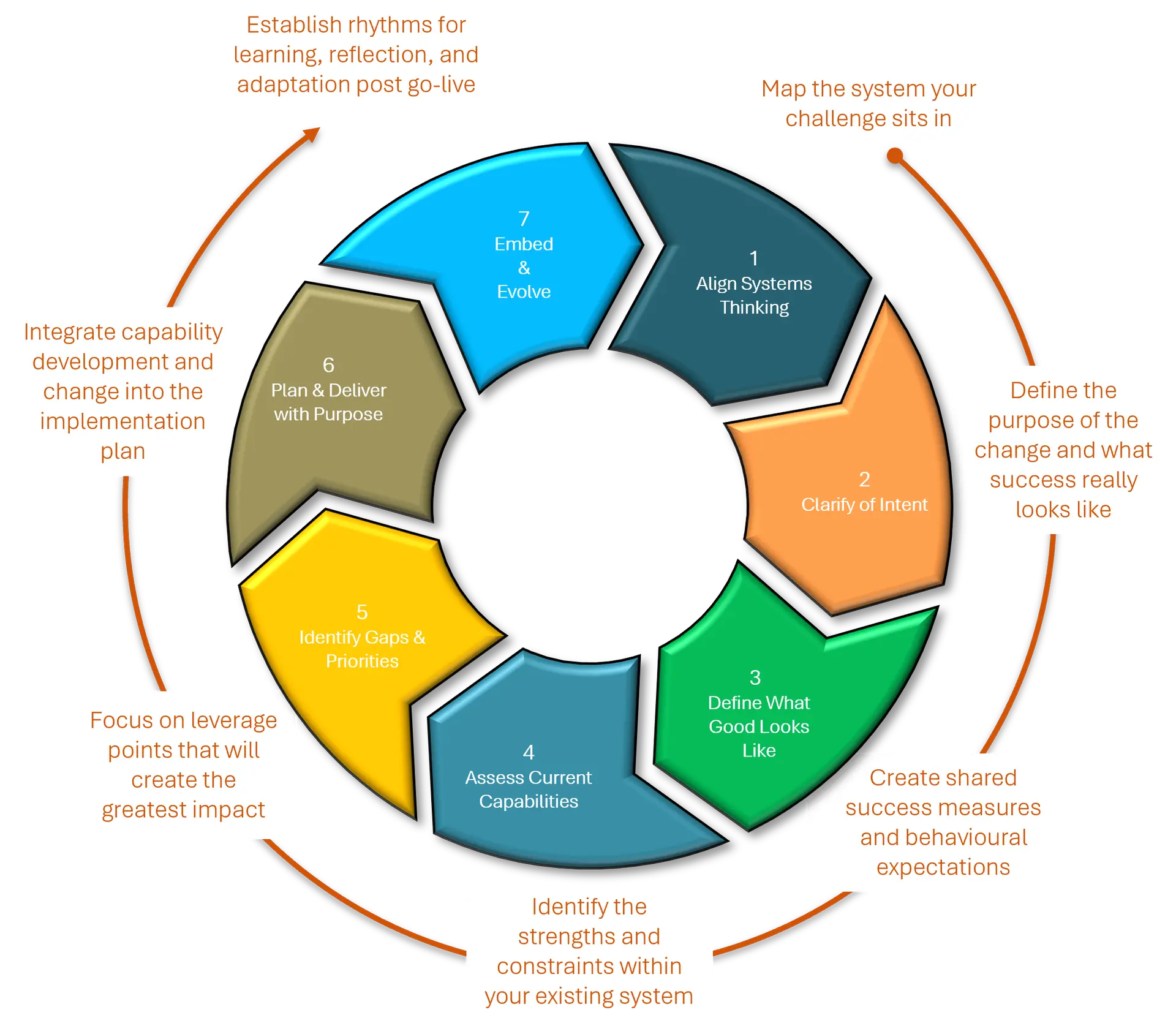
These steps turn implementation projects into capability journeys - creating organisations that learn faster and adapt with confidence.
Building Culture for Adoption
Adoption is not compliance; it’s commitment. People adopt what they believe in and understand. Culture determines whether technology change feels like empowerment or imposition.
Leaders play a pivotal role in shaping that culture. Their behaviour signals what truly matters - whether experimentation is safe, whether feedback will be heard, whether accountability is shared or avoided.
When leaders communicate openly, align decisions to purpose, and model adaptability, they create the trust needed for people to engage with change.
Measuring What Matters
Traditional transformation metrics (budgets, timelines, and delivery milestones) tell only part of the story. They measure activity, not adoption. Completion, not capability. Progress, not performance.
True success is seen in behaviours, flow, and trust.
System readiness requires looking beyond standard KPIs to the signals that reveal whether the environment around the technology is evolving as intended. These include both leading and lagging measures, as well as signal metrics: the early indicators that show whether change is taking hold within the system.
Leading indicators
(early signs that the system is aligning and people are engaging)
- clarity of purpose and strategic intent
- quality of collaboration across functions
- leadership alignment on priorities and behaviours
- confidence and engagement signals from teams
- openness to feedback, experimentation, and learning
Signal metrics
(behavioural clues and system patterns that shift before formal outcomes change)
- cycle time of decisions: how quickly teams can make aligned decisions without escalation
- rework volume: amount of work needing correction or duplication due to unclear processes
- handover quality: number of back-and-forths needed before work can progress
- meeting load vs. value: the proportion of meetings that create clarity rather than friction
- time to meaningful data insight: how long it takes for teams to generate and act on new information
- cross-functional touchpoints: frequency and quality of collaboration across key interfaces
- psychological safety signals: measured through pulse checks or participation behaviour
These are often the clearest indicators of whether new technology is being integrated into the system, or simply layered on top of old patterns.
Lagging indicators
(outcomes that validate long-term impact)
- adoption and utilisation rates
- customer satisfaction and experience outcomes
- process efficiency, flow, and cycle time
- staff retention, capability uplift, and wellbeing
By combining data and dialogue, organisations can see not just whether technology is working, but whether the system around it is thriving.
Business Vitality’s Intelligent Operating Framework supports this continuous learning loop - turning insights into action and action into improvement.
System Readiness in Practice
Across both public and private sectors, we’ve seen that system readiness consistently predicts transformation success. In one organisation, fragmented processes and unclear accountabilities had stalled a major system rollout. By applying Business Vitality's 7-Step Capability Development Roadmap, they clarified purpose, defined success measures, and built a cross-functional rhythm that sustained improvement long after the project closed.
Recent empirical studies highlight how readiness across strategy, culture, and capability drives success:
Case Study 1: Dual Transformation in Manufacturing
(Tijuana, 2024)
System Readiness Built the Foundation for Digital & Sustainable
Transformation
A 2024 study of advanced manufacturing firms in Tijuana examined why
some organisations successfully delivered dual transformation (digital and
sustainable) while others stalled. The research found that technology
investments alone were not predictive of success. Instead, the strongest
drivers were elements of system readiness: strategic clarity, leadership
alignment, a cohesive culture, and well-designed processes that supported the
new digital ways of working. Organisations that established cross-functional
governance, built data capability, and invested in developing leaders’
transformation competencies saw significantly higher performance outcomes.
Those that focused primarily on acquiring new tools struggled with adoption,
integration, and decision-making. The study concluded that transformation
accelerates when the organisational system is intentionally designed to support
the new digital capabilities - reinforcing the principle that readiness must
precede implementation. SpringerLink
Case Study 2: Public Sector Digital Transformation
Readiness (Global Sample, 2024)
People, Culture, and Governance Determined Success More Than Technology
A 2024 global analysis of public service organisations looked at the
factors that predicted successful digital transformation. The study found that
people-centred readiness - including digital literacy, openness to
learning, trust in leadership, and collaborative culture - was more
influential than technology maturity. Organisations with adaptive governance
structures, clear accountability pathways, and engaged leadership were able to
integrate new digital systems faster and with fewer issues. In contrast, teams
operating in rigid hierarchies or low-trust environments experienced delays,
resistance, and inconsistent adoption. Crucially, the research showed that
transformation was not a technology challenge but a system challenge, requiring
coherence between skills, structures, culture, and leadership. MDPI
Case Study 3: Enterprise-Level Transformation Across
Industries (2025)
High
Performance Resulted When Organisations Treated Transformation as a System
Problem
A 2025 cross-industry study analysed transformation initiatives across
technology, banking, logistics, and manufacturing firms. It compared
organisations that approached transformation as technology deployment with
those that approached it as system redesign. The findings were clear:
organisations that built system-readiness - re-examining workflows,
enabling distributed decision-making, redesigning governance, investing in
leadership capability, and strengthening cross-functional collaboration -
achieved significantly higher adoption rates and performance outcomes.
Conversely, organisations that expected technology alone to solve fragmentation
saw low utilisation, increased rework, and rising transformation fatigue. The
study highlighted that the highest-performing organisations were those that
incorporated “continuous learning loops” (mechanisms for real-time
sensing, reflection, and adaptation) into their operating rhythm. Elsevier
These findings reinforce the argument that organisations must build system-readiness - the alignment of people, purpose, processes, and leadership - before or in parallel with major technology deployment. When readiness is addressed, tools become enablers; when it’s ignored, transformation risks stalling or failing.
Starting with System Readiness
The best time to think about system readiness is before implementation begins, but it’s never too late to start. Even in-flight programmes benefit from stepping back to ask:
“Are we ready for this change, or are we repeating the same patterns in a new system?”
Business Vitality helps organisations answer that question with clarity and confidence. Through structured discovery sessions, readiness assessments, and leadership retrospectives, we identify what’s most important right now and where effort will yield the highest return.
_________________________________________________________________________________________________________________
About Business Vitality
At Business Vitality, we help organisations
perform, adapt, and thrive by building system-ready capability. We combine
systems thinking, organisational design, leadership development, and cultural alignment
to create lasting impact.
Our frameworks provide practical pathways for leaders to align purpose, people, and performance.